

















Not all appreciation is profit
Stamp duty, taxes, loan interest and ownership costs affect actual returns
Property Pulse
Many property owners assume that profit from a real estate investment is simply the difference between the purchase price and the sale price. However, financial planners say the actual return from a property transaction can be very different once acquisition costs, ownership expenses and selling costs are taken into account.
Consider a simple example. A buyer purchases a property for ₹1 crore and sells it five years later for ₹1.8 crore. On paper, the property has appreciated by ₹80 lakh.
But appreciation and profit are not necessarily the same thing.
Experts say many buyers focus on the increase in property value while overlooking the total cost of ownership. The real return can only be assessed after accounting for various expenses incurred during the period of ownership.
For under-construction properties, GST may form part of the acquisition cost. Buyers also incur stamp duty and registration charges at the time of purchase. Brokerage fees may be payable during both purchase and sale transactions.
Home loan borrowers face another important consideration. While property values may rise over time, interest paid on a long-term home loan can substantially increase the effective cost of ownership. Buyers should therefore evaluate returns after considering financing costs as well.
Maintenance expenses are another frequently overlooked factor. Apartment owners pay monthly maintenance charges throughout the ownership period, while periodic repairs, upgrades and replacement of fixtures add to long-term costs. Clubhouse charges, parking fees and other project-related expenses can further increase the overall investment.
Taxes also play a role. Depending on the nature of the transaction and prevailing regulations, capital gains tax can reduce the amount ultimately retained by the seller.
Financial planners therefore advise buyers to evaluate property purchases using a broader framework rather than focusing solely on appreciation. For end-users, a home provides benefits beyond financial returns, including stability, convenience and long-term security. For investors, however, understanding the complete cost structure is essential for accurately assessing performance.
The key takeaway is simple: a property's sale price tells only part of the story. The real measure of success is not how much the property's value increased, but how much money remains after all ownership and transaction costs are accounted for.
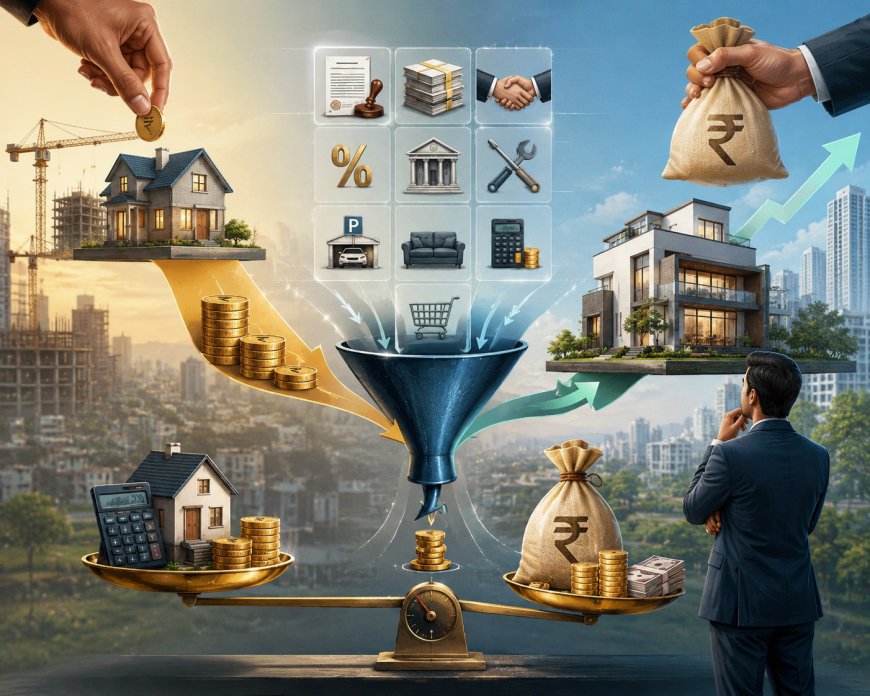
APPRECIATION ≠ PROFIT
Example:
Bought for: ₹1 crore.
Sold for: ₹1.8 crore.
Appreciation: ₹80 lakh.
But Don't Forget
• Stamp duty & registration.
• GST (where applicable).
• Brokerage.
• Home loan interest.
• Maintenance charges.
• Repairs & upgrades.
• Parking & clubhouse fees.
• Capital gains tax.
• Other ownership expenses.
REAL RETURN = APPRECIATION MINUS ALL COSTS
What's Your Reaction?
 Like
0
Like
0
 Dislike
0
Dislike
0
 Love
0
Love
0
 Funny
0
Funny
0
 Angry
0
Angry
0
 Sad
0
Sad
0
 Wow
0
Wow
0