




























Court cases no shield against action by civic bodies.
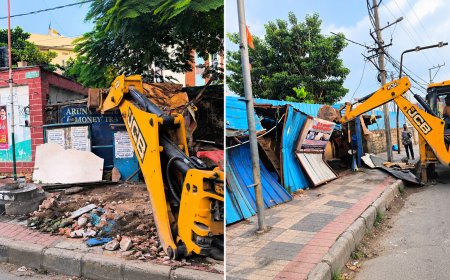
The Telangana High Court ruled that courts cannot protect illegal constructions from civic action. Hearing a Jeedimetla unauthorized construction case, the court said builders who deliberately violate sanctioned plans should not expect relief after completing the building.

Community Pulse
The Telangana High Court said courts cannot be used as a shield to protect illegal structures from civic action. The court observed that building permissions are governed by planning regulations, permissible built-up area and plot dimensions, and cannot be justified on grounds unrelated to construction rules. Hearing a case related to an alleged unauthorised construction in Jeedimetla, Justice N.V. Shravan Kumar observed that individuals who deliberately violate sanctioned building plans and later seek judicial protection should not expect relief merely because a building has already been constructed.
The court expressed concern over the growing tendency of some builders and property owners to disregard approved plans and approach courts only after municipal authorities initiate action. Justice Shravan Kumar remarked that such practices undermine the rule of law and cannot be encouraged. The case involved a businessman who allegedly carried out construction inviolation of sanctioned norms on a 267-square-yard plot in Jeedimetla. Municipal authorities subsequently sealed the property. The petitioner approached the High Court seeking removal of the seal and protection from further action.
During the hearing, the petitioner's counsel argued that the matter was linked to a family property dispute. However, the court observed that building permissions are governed by planning regulations, permissible built-up area and plot dimensions, and cannot be justified on grounds unrelated to construction rules. The court noted that unauthorised constructions not only violate municipal regulations but can also affect neighbouring property owners, infrastructure capacity and planned urban development.
Justice Shravan Kumar made it clear that while genuine or inadvertent errors may be viewed differently, deliberate violations of approved plans would not be tolerated. The court further warned that petitioners attempting to misuse judicial proceedings to protect illegal constructions could face substantial penalties. Finding the explanations offered by the petitioner unsatisfactory, the court allowed authorities to continue with the sealing process. The matter has been posted for further hearing on July 7.
HIGH COURT'S MESSAGE
• Follow sanctioned building plans.
• Do not assume violations can be regularised later.
• Courts may not protect deliberate violations.
• Illegal construction can attract penalties.
WHY IT MATTERS
• Protects planned urban development.
• Safeguards neighbouring properties.
• Reduces pressure on civic infrastructure.
• Encourages compliance with building norms.
What's Your Reaction?
 Like
0
Like
0
 Dislike
0
Dislike
0
 Love
0
Love
0
 Funny
0
Funny
0
 Angry
0
Angry
0
 Sad
0
Sad
0
 Wow
0
Wow
0