
























Hyderabad's Annual Office Absorption to Rise from 12–13 Mn to 50–60 Mn Sq Ft Over the Next 2–3 Years, Says JLL MD Sandip Patnaik
Hyderabad's office market outlook is driven by GCC expansion and occupier demand, even as housing pressures and infrastructure gaps shape its next phase of urban growth.

SAMUEL JOSHUA
Growing Global Capability Centre (GCC) investments and sustained occupier demand are expected to drive Hyderabad's commercial real estate market over the next few years, strengthening its position among India's leading office destinations while bringing infrastructure readiness and long-term urban planning into sharper focus.
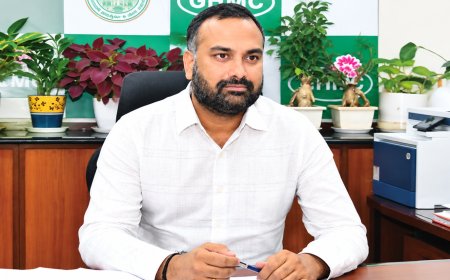
"Hyderabad is now the second-highest city in terms of annual office space absorption at around 12-13 million sq ft, with the market pipeline standing at 23-25 million sq ft. I am very confident, despite the AI scare, that Hyderabad will stabilise very soon and annual office absorption could reach 50-60 million sq ft in the next 2-3 years," said Sandip Patnaik, Senior Managing Director, JLL, in Hyderabad Economic Forum 2026 at SAS I- Tower, Nanakramguda.
India currently hosts around 1,700-1,800 Global Capability Centres (GCCs), of which nearly 20-22 per cent are located in Hyderabad. Patnaik noted that the city recorded a higher absolute number of GCC additions than Bengaluru in December 2025, highlighting its growing appeal among global occupiers.
Hyderabad has evolved significantly over the past decade and reached a level of maturity where corporates, GCCs, high-net-worth individuals (HNIs), investors and global capital continue to drive its growth, he said, adding that the city's trajectory is no longer dependent on bureaucrats or government intervention alone. While short-term market cycles may persist for one to three years, the city's long-term growth story over the next five to seven years remains intact.
On the residential front, Patnaik said Hyderabad's housing market has been under pressure over the past one to one-and-a-half years despite strong office leasing, citing high unsold inventory and slower sales. He attributed the slowdown to younger homebuyers conserving cash amid global uncertainties and opting to rent instead of buying rather than commit to the 20 per cent down payment required for a home. With apartments in Hyderabad now typically priced at Rs 1.2 crore to Rs 1.4 crore or more, many prospective buyers are also postponing purchases, he added.
The continued expansion of GCCs and office space will support long-term housing demand as more professionals move to the city, he said, adding that Hyderabad retains an advantage over competing markets due to its relatively better road network and availability of developable land. However, residential growth is likely to remain concentrated in the western corridors unless new employment hubs emerge elsewhere, as occupiers and homebuyers continue to prefer established micro-markets despite improving connectivity to the east, north and Shamshabad.
Talent availability remains the primary factor influencing location decisions for multinational companies, with real estate costs ranking much lower in investment considerations, Patnaik said, adding that office development remains concentrated in western Hyderabad as corporate occupiers continue to prefer established business districts despite improving connectivity to the east, north and other parts of the city. He cautioned that unless commercial growth becomes more geographically balanced, rising traffic congestion and pressure on urban infrastructure could leave Hyderabad facing challenges similar to Bengaluru's technology corridor.
Future office developments must focus not just on adding supply but on long-term design, sustainability, PropTech integration and future-proofing buildings for the next 25-30 years, according to Sandip Patnaik, with occupiers now prioritising innovative, flexible and sustainable workspaces. He also flagged water security, traffic congestion and civic infrastructure as key challenges, saying Hyderabad's long-term competitiveness will require greater collaboration between the government, developers and corporate stakeholders, along with stronger investment in public infrastructure beyond project boundaries.
On artificial intelligence, Patnaik said its long-term impact on office demand remains uncertain. While AI is expected to automate routine roles, it is also likely to create new categories of jobs. The eventual impact on office absorption will depend on whether job creation offsets displacement, making it too early to predict the sector's long-term trajectory.
What's Your Reaction?
 Like
0
Like
0
 Dislike
0
Dislike
0
 Love
0
Love
0
 Funny
0
Funny
0
 Angry
0
Angry
0
 Sad
0
Sad
0
 Wow
0
Wow
0