























Waste Segregation Responsibility Now Lies with Hyderabad Gated Communities Under SWM Rules
Hyderabad has introduced stricter enforcement of waste segregation norms under the Solid Waste Management (SWM) Rules, 2026, making gated communities, malls and hotels with over 20,000 sq.
SAMUEL JOSHUA
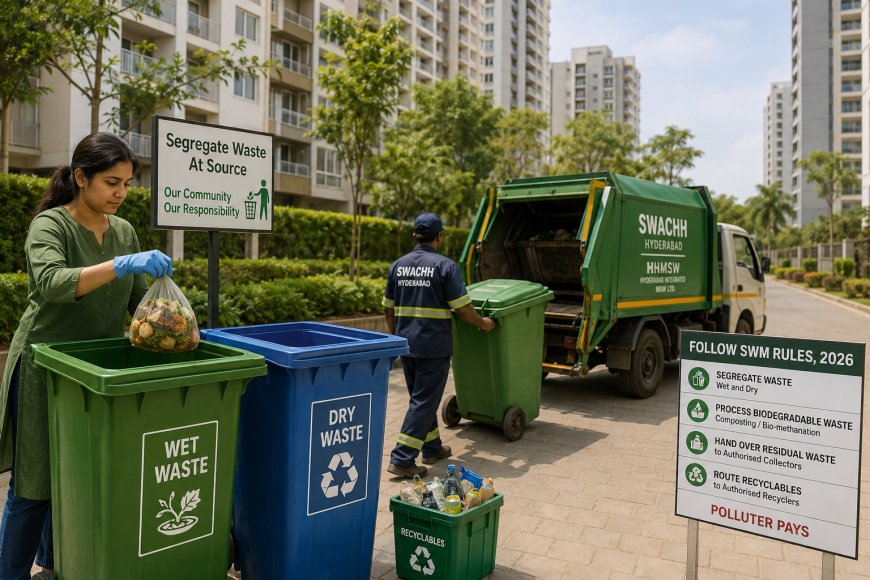
Waste segregation norms in gated communities across Hyderabad are set to face tighter enforcement, with authorities shifting greater responsibility for source-level compliance from local bodies to residential communities themselves under the new Solid Waste Management (SWM) Rules, 2026. The move targets improved segregation practices and stricter adherence to on-site waste handling standards in residential clusters.
The Greater Hyderabad Municipal Corporation (GHMC), in partnership with Hyderabad Integrated MSW Ltd (HIMSW), a subsidiary of Ramky Enviro Engineers Limited, has launched a citywide enforcement drive across GHMC limits, including Cyberabad Municipal Corporation (CMC) and Malkajgiri Municipal Corporation (MMC) areas, bringing the urban region under uniform waste management standards.
Under the new framework, any gated community, mall, or hotel with a built-up area of 20,000 square metres or more and generating over 100 kg of waste per day will be classified as a Bulk Waste Generator (BWG). These entities must follow a structured waste management system, obtain an Extended Bulk Waste Generator Responsibility (EBWGR) certificate and ensure environmentally compliant disposal. Non-compliance may attract financial penalties.
With Hyderabad generating nearly 6,000 tonnes of waste daily, authorities have launched a 99-day action plan and a Rs 500 crore waste-to-energy push to strengthen accountability across the system.
In gated communities, residents are required to segregate waste into wet and dry streams at the point of generation. Bulk Waste Generators (BWG) must process biodegradable waste within their premises through composting or bio-methanation, while only residual waste is handed over to authorised collectors. Recyclables must be routed directly to authorised recyclers or waste pickers without mixing with general waste.
Within residential layouts, collection is carried out through Ramky’s Swachh auto tipper network, which transports segregated waste from designated points to Secondary Collection and Transport Points (SCTPs). Hyderabad has around 100 SCTPs, each costing approximately Rs 1.3 crore, equipped with Portable Self-Compactors to reduce waste handling and improve operational efficiency.
Non-compliant entities may face action under the "Polluter Pays" principle, with enforcement agencies empowered to initiate action against violations.
User charges for waste collection, transport and disposal are fixed at Rs 2.90 per kg for the 2022–23 financial year. Bulk Waste Generators transporting segregated waste directly to the facility are eligible for reduced charges of Rs 1.16 per kg. The system is supported by digital monitoring through the Ramky Foundation, which uses a three-stage reporting mechanism to track waste movement.
Compliance monitoring has also been strengthened through Facial Recognition System-based attendance tracking and circle-wise monitoring under the 99-day plan. Regulatory oversight remains strict, with the National Green Tribunal (NGT) earlier imposing a Rs 1 lakh penalty on both GHMC and its operating agency for non-compliance, highlighting the legal importance of the current sanitation drive.
What's Your Reaction?
 Like
0
Like
0
 Dislike
0
Dislike
0
 Love
0
Love
0
 Funny
0
Funny
0
 Angry
0
Angry
0
 Sad
0
Sad
0
 Wow
0
Wow
0