
























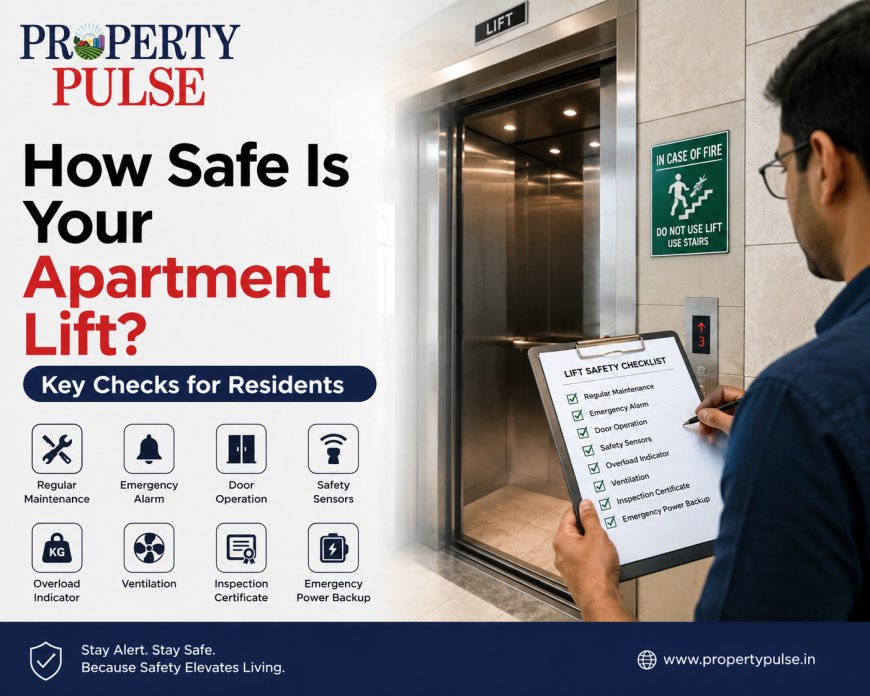
How Safe Is Your Apartment Lift? Key Checks for Residents
“Safety begins with lifts” means lift (elevator) safety should start from proper design, installation, and regular maintenance. It highlights the importance of following safety standards, routine inspections, and user awareness to prevent accidents in residential and commercial buildings.
Property Pulse
Hyderabad's skyline is rising rapidly, with high-rise apartments, gated communities and commercial towers becoming increasingly common across the city. Along with this vertical growth comes a growing dependence on elevators and escalators, which have become an essential part of everyday life for lakhs of residents. However, safety experts and consumer groups point out that Telangana is yet to implement a dedicated law governing the installation, operation and maintenance of lifts and escalators, even more than a decade after the formation of the state.
The issue has gained attention amid reports of lift-related mishaps, technical failures and maintenance concerns in residential and commercial buildings. While most elevators operate safely, experts say the risks increase when maintenance schedules are ignored or safety systems are not periodically inspected.Why residents should care Unlike visible building defects, lift-related issues often remain unnoticed until a breakdown or accident occurs. In many apartment complexes, residents depend entirely on maintenance contractors and equipment suppliers to ensure safe operation. Consumer groups argue that a dedicated regulatory framework could help establish uniform safety standards, periodic inspections and clear accountability for building owners, maintenance agencies and equipment supplier.What a dedicated law will do.
Safety experts say a dedicated Lifts and Escalators Act could introduce:
* Mandatory licensing of lifts.
* Periodic safety inspections.
* Certification of installations.
* Standardised maintenance requirements.
* Accountability for safety violations.
* Penalties for negligence.
Several states, including Maharashtra, Karnataka, Tamil Nadu and Kerala, already have regulations governing lift safety and operation.
The high-rise challenge
As Hyderabad witnesses increasing construction of residential towers ranging from 10 to 30 floors and beyond, lift reliability is becoming as important as water supply, electricity and fire safety.Experts note that older lifts require periodic modernisation, while newer installations must comply with prescribed safety standards, emergency communication systems and backup power arrangements. Consumer activists have called for stronger oversight and regular inspections to ensure that rapid urban growth is matched by adequate safety mechanisms.
Role of residents
Even in the absence of a dedicated law, residents can take certain precautions:
* Ensure annual safety inspections are conducted.
* Verify maintenance contracts are active.
* Check availability of emergency alarms and communication systems.
* Avoid overloading lifts.
* Ensure children do not use malfunctioning lifts unsupervised.
* Report unusual noises or operational issues immediately.
Vertical mobility
* Essential in high-rise buildings.
* Used daily by thousands of residents.
* Breakdowns can pose safety risks.
* Maintenance is critical.
Lifts Act will oversee installations, mandate regular inspections,
safety certifications and accountability for violations.
RESIDENT CHECKLIST
* Annual inspection records.
* Active maintenance contract.
* Emergency alarm system.
* Backup power support.
* Functional door sensors.
What's Your Reaction?
 Like
0
Like
0
 Dislike
0
Dislike
0
 Love
0
Love
0
 Funny
0
Funny
0
 Angry
0
Angry
0
 Sad
0
Sad
0
 Wow
0
Wow
0