






















Hyderabad’s Construction Demand Rises, TG Plans 0.08 MnT Steel Capacity Boost
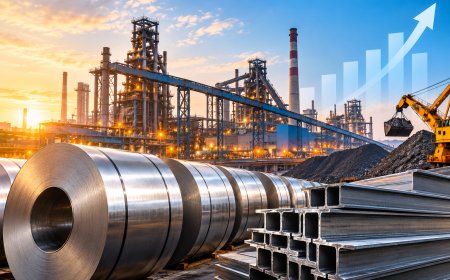
Telangana produced 2.4 MnT of steel in FY2026 against an existing capacity of 3.86 MnT, with housing, infrastructure and specialised industries driving demand.
SAMUEL JOSHUA
Telangana produced 2.4 million tonnes (MnT) of crude steel in FY2026 against an existing production capacity of 3.86 MnT.
The state plans to add only 0.08 MnT of capacity by FY2030, compared with 15.08 MnT planned across South India. The limited expansion comes as Hyderabad’s housing, office construction and infrastructure projects continue to create demand for steel.
South India has a total steel production capacity of 46 MnT and produced 31 MnT in FY2026. These figures are from an assessment by BigMint, an India-based commodities market intelligence firm, in association with the Telangana Iron & Steel Manufacturers Association (TISMA).
Steel is one of the major materials used in residential construction. Homes typically require 3.5 to 6 kg of steel per sq ft, mainly in the form of reinforcement bars used to strengthen concrete structures. High-rise buildings and data centres also require heavy steel sections, plates and coated sheets, depending on their design and construction needs.
Also Read: NAREDCO Property Show Set To Draw Over 20K Registrations
Steel Production in South India
South India accounts for 58.1% of India’s Grade A office space absorption, 32.4% of the country’s construction gross value added (GVA) and 44.2% of its planned data centre capacity.
Across the region, 38.8 lakh houses have been sanctioned under the Pradhan Mantri Awas Yojana-Urban (PMAY-Urban). Nationally, construction accounted for 31.8% of finished steel consumption in FY2024, while infrastructure projects accounted for another 28.8%. Together, these sectors used 60.6% of the finished steel consumed in the country.
Hyderabad absorbed 11.4 million sq ft of Grade A office space in calendar year 2025. Bengaluru recorded 28.7 million sq ft, while Chennai accounted for 10.1 million sq ft. Five other southern cities together recorded 36.2 million sq ft, underlining the scale of commercial property development across the region.
K.K. Maheshwari, President of the Federation of Telangana Chambers of Commerce and Industry (FTCCI), noted the need for continued government support on policy matters and energy costs. These remain important considerations for steelmakers and could influence their decisions on expanding production.
Also Read: Musi Riverfront Project to Include 6 Bridges, 6-Lane Roads
Growing Demand for Steel in Hyderabad
However, rising construction demand does not necessarily mean that more steel will be produced locally. According to the BigMint assessment, South India already has sufficient supplies of reinforcement bars and structural steel sections.
Blast furnaces account for 58.5% of the region’s steelmaking capacity, while induction furnaces account for 31.3%. Builders may still need to source certain heavy steel sections and specialised steel sheets from mills in eastern India or from overseas, depending on the grades and specifications required.
Telangana also has demand for specialised steel from industries beyond construction. Hyderabad is a major centre for real estate, mobility, industrial activity, electronics and aerospace.
Aerospace and defence account for 33.4% of Telangana’s total exports. These industries use specialised materials such as alloy steel, stainless steel and thin steel sheets that must meet specific technical requirements.
Hyderabad is also identified as a major source of scrap metal, alongside Bengaluru and Chennai. Better scrap collection and processing facilities near the city could help local steelmakers recover and reuse metal.
The proposed Hyderabad Metro Rail Phases 2A and 2B, along with housing and infrastructure projects, could also support steel demand in the coming years.
Vivek Nishant Nath, Director (Commercial) of NMDC Limited, highlighted the availability of raw materials as an important factor in supporting future steel production.
For Telangana, the challenge is to connect its existing steel production capacity with demand from real estate, infrastructure and other industries. With only 0.08 MnT of additional capacity planned by FY2030, the extent to which local production can grow alongside demand remains an important consideration.
What's Your Reaction?
 Like
0
 Dislike
0
 Love
0
 Funny
0
 Angry
0
 Sad
0
 Wow
0