



























Big Relief for Telangana Builders as Govt Eases Construction Norms
Telangana government has eased construction norms, offering major relief to builders and developers in the Hyderabad real estate market. Key reforms include reduced RERA mortgage requirements, simplified building permissions, and new rules for mixed-use development and approvals.

In a major relief to the construction and real estate sector in Telangana, the state government has agreed to address several long-pending issues faced by builders and developers, a move that is expected to give fresh momentum to the industry.
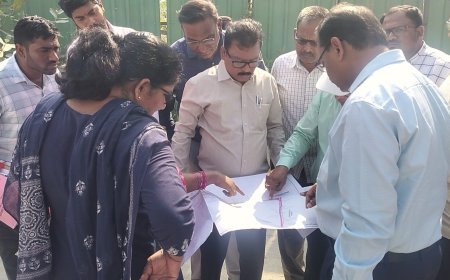
The decision was taken during a high-level meeting held recently at the Secretariat, chaired by Jayesh Ranjan, Special Chief Secretary, MA&UD department, with representatives of various real estate associations from the state.
The meeting deliberated extensively on regulatory, procedural and operational challenges affecting the sector, following which the government agreed to implement a series of reform measures. Among the key decisions, the government has agreed to revive the instalment payment scheme for building permission fees, and said the proposal would also be examined for implementation within the Greater Hyderabad Municipal Corporation (GHMC) limits. However, interest will be levied on delayed payments in line with Hyderabad Metropolitan Development Authority (HMDA) norms. The government also agreed to reduce the mortgage requirement under RERA from 10 per cent to 5 per cent, citing enforcement-related issues.
On irrigation clearances, the government said issuing No Objection Certificates (NOCs) at the Assistant Engineer level may not be appropriate, as determining Full Tank Level (FTL) requires detailed technical assessment. It clarified that where FTL final notifications for tanks have already been issued jointly by the Revenue and Irrigation departments, no separate irrigation NOC will be required. The government said it would aim to complete pending FTL final notifications for other lakes within one year.
The government clarified that the new ‘Build Now’ online building permission system was launched in March 2025 and ran parallel to TG-bPASS until December 31, 2025. Files in the final stage under TG-bPASS will continue to receive fee letters and proceedings through the same platform.
Within GHMC limits, the Water Feasibility Certificate requirement has been removed, except for high-rise buildings and projects with more than 20 dwelling units. The government also said a “deemed approval” provision would be introduced after 15 days.
On floor height norms, the government agreed to allow a 10 per cent increase per floor, following representations from developers. It also agreed to rationalise setback rules related to balconies, clarifying that there is no separate concept of a “covered balcony” and removing balcony projection restrictions within setbacks.
The government further agreed to permit mixed-use development across all zones, except in prohibited areas, and to collect change-of-land-use fees at the building permission stage itself. Mixed-use development will be allowed on plots abutting roads of 80 feet and above.
Clear timelines were also fixed for building plan validity: three years for individual residential buildings, five years for non-high-rise commercial and residential projects up to 100 units, and six years for high-rise apartments and large gated villa communities. An automatic revalidation for two additional years, subject to fee payment, is already in place.
On Transferable Development Rights (TDR), the government said TDR details will be submitted after issuance of the fee letter, with verification by designated officers before final approval. The system will also be enabled to calculate TDR based on market value once applicants input the required data.
The government also agreed to simplify and rationalise the fee structure under the revised Common Building Rules and clarified that property tax will be levied only after issuance of an Occupancy Certificate. To address delays caused by nala gap issues in Dharani and Bhu Bharati portals, GHMC and HMDA will be authorised to collect nala charges on behalf of the Revenue Department and release mortgages.
In another relief, the government clarified that two ramps are not mandatory for small plots, allowing flexibility based on plot size and building type. It also agreed to rationalise the unified fee structure to make the approval process simpler and more transparent. Industry bodies welcomed the decisions, stating that the government’s move would revive sentiment in the construction sector and accelerate stalled projects across Telangana.
What's Your Reaction?
 Like
0
Like
0
 Dislike
0
Dislike
0
 Love
0
Love
0
 Funny
0
Funny
0
 Angry
0
Angry
0
 Sad
0
Sad
0
 Wow
0
Wow
0