
















“10% TDR Rule in Telangana: Why Hyderabad Home Prices Are Set to Rise”
“10% TDR Rule in Telangana: Why Hyderabad Home Prices Are Set to Rise”
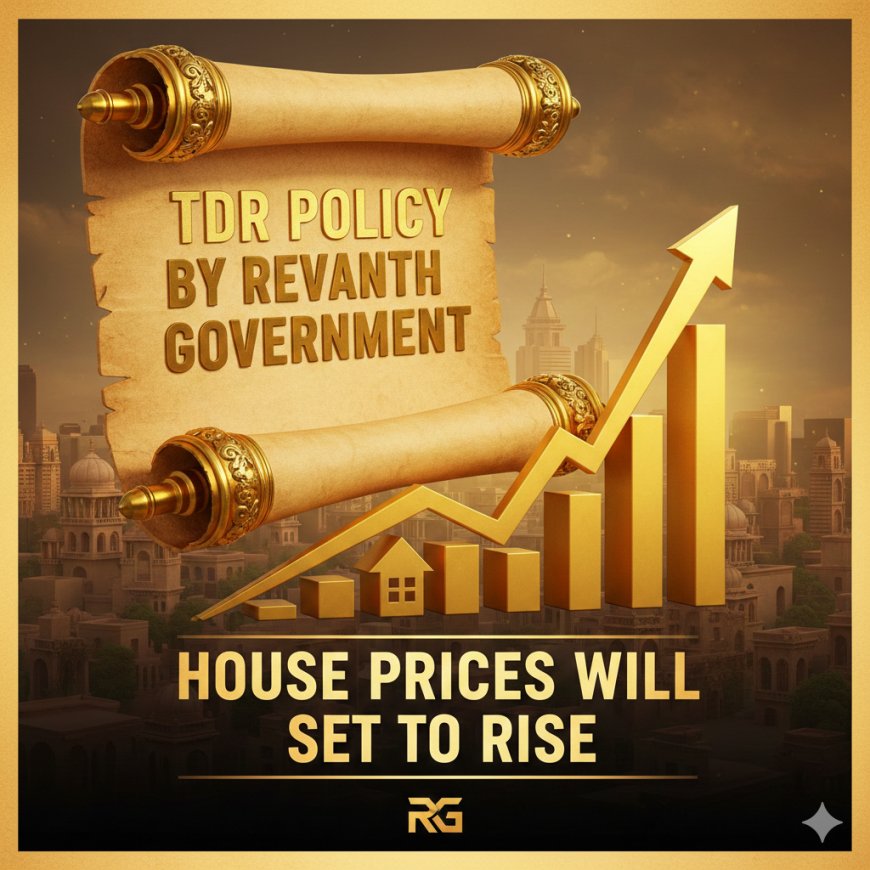
For nearly two years, Hyderabad’s residential real estate market remained cautious. Sluggish sales, fewer new project launches, and rising home loan interest rates had collectively cooled buyer sentiment. Among middle-class and first-time homebuyers, there was growing hope that property prices might stabilise after years of steep escalation.
That optimism, however, now appears uncertain.
A recent policy decision by the Telangana government mandating 10% Transferable Development Rights (TDR) for high-rise residential projects has triggered renewed concern across Hyderabad’s real estate sector. While the policy is intended to generate resources for critical urban infrastructure—such as the Musi River rejuvenation, road expansion, and stormwater drainage—its immediate impact could be a sharp rise in apartment prices, directly affecting homebuyers.
Industry estimates suggest that apartment prices in upcoming projects could increase by ₹150 to ₹572 per square feet, depending on location, land value, and building height. This escalation has the potential to significantly reshape housing affordability in the city.
Under the newly issued Government Order, all residential and mixed-use buildings exceeding 10 floors are required to purchase TDR equivalent to 10% of the built-up area beyond the 10th floor. Submission of TDR has become mandatory for obtaining building plan approvals. The TDR value is calculated based on prevailing guideline values, in addition to GST and statutory charges. Notably, the policy does not provide exemptions for premium locations, high land-cost corridors, or large-scale developments.
While TDR is conceptually designed to balance development rights with infrastructure needs, developers argue that market realities make absorption of this cost impractical. With land prices in Hyderabad having risen sharply over recent years, developers contend that TDR expenses will inevitably be passed on to buyers through higher base prices and increased per-square-foot rates. For middle-income and first-time buyers, this translates into reduced affordability and higher EMIs, without any corresponding improvement in amenities.
The financial impact varies across locations. In western Hyderabad areas such as Kukatpally and Nanakramguda, a typical 40-floor tower on one acre could face an additional burden of nearly ₹17.66 crore, translating into an added cost of approximately ₹442 per square feet. In central zones like the Azamabad Industrial Area, the impact is more pronounced, with price increases ranging between ₹536 and ₹572 per square feet, significantly affecting project economics.
In Kokapet Neopolis, the situation is more complex. While the per-square-foot TDR impact is relatively lower, extremely high land costs—often exceeding ₹130 crore per acre—mean developers depend heavily on tall towers and high FSI for viability. Additional TDR charges further compress margins, pushing projects toward much higher selling prices, even in the premium segment.
From the government’s perspective, the objective is to mobilise funds for infrastructure while reducing pressure on public finances. However, industry stakeholders argue that the policy effectively shifts the infrastructure funding burden onto homebuyers. Concerns have also been raised over the absence of phased implementation, location-based differentiation, safeguards for affordable housing, and a cap on cumulative cost impact.
Early market indicators suggest growing caution among developers. Several high-rise proposals are reportedly being reassessed or paused, while some developers are shifting toward lower-height projects. If this trend continues, Hyderabad could witness constrained housing supply, potentially leading to further price escalation.
For middle-class families already grappling with higher construction costs, rising EMIs, and increased registration and GST charges, the TDR-linked price hike could be decisive. Industry estimates indicate that a home priced at ₹1 crore could rise to ₹1.15 crore, driven largely by regulatory costs.
Developers and industry bodies have urged the state government to revisit the policy by reassessing the 10-floor threshold, introducing graduated or zone-specific TDR slabs, and protecting ultra-high land-cost corridors such as Neopolis. They emphasise that their concerns are not against infrastructure development, but against a disproportionate cost transfer to end buyers.
The 10% TDR policy reflects Telangana’s ambition to fund Hyderabad’s next phase of urban growth. However, without careful calibration, it risks undermining housing affordability and slowing residential development. The key question now is not whether infrastructure requires funding, but how that cost is shared—and at what impact on aspiring homeowners.
For Detailed Story.. Look at epaper.regnews.in
What's Your Reaction?
 Like
0
Like
0
 Dislike
0
Dislike
0
 Love
0
Love
0
 Funny
0
Funny
0
 Angry
0
Angry
0
 Sad
0
Sad
0
 Wow
0
Wow
0